

High-Paying Bitcointalk Signature Campaigns: Historical Rates Explained
Published · Natty Gbara · Updated
Some Bitcointalk signature campaigns advertised substantial weekly rewards. This historical comparison explains the figures, special conditions and lessons behind the headlines.

Some Bitcointalk signature campaigns became memorable for the rewards they offered established forum members. Advertised rates reached hundreds of dollars per participant per week, while earlier campaigns sometimes calculated payments directly in Bitcoin.
However, a headline such as “up to $225 per week” does not explain who qualified, how much work was eligible or whether bonuses were included.
This historical comparison examines selected high-paying campaigns and the conditions behind their advertised rewards. It is not a list of current opportunities, an endorsement of the businesses or a complete ranking of every campaign ever operated.
The useful lesson is how to read campaign terms accurately—and what those terms reveal about the cost of maintaining a forum presence.
What does “highest-paying” actually mean?
A meaningful comparison needs a consistent measure.
This article focuses on advertised weekly rewards available to an individual participant under the cited terms. That is different from:
The total weekly campaign payroll.
The amount a business spent over the campaign’s lifetime.
Payments actually received by every participant.
Exceptional bonuses offered to selected members.
The current value of Bitcoin earned years earlier.
A campaign offering a $100 standard payment and a possible $30 quality bonus should not be presented as paying everyone $130.
Likewise, a special rate available to a small group should not be described as the standard rate for an entire forum rank.
Campaign opening posts can also be edited. The terms visible today may describe a later period rather than the original launch conditions.
Selected high-paying dollar-denominated campaigns
The following figures describe advertised terms or historical campaign records. They should not be treated as current rates or typical market prices.
| Campaign | Historical weekly figure | Important qualification |
|---|---|---|
| ChipMixer | Up to $300 | $6 per eligible post, with a maximum of 50 paid posts |
| Mixero | Advertised up to $250 | Historical campaign headline; applicable terms varied over time |
| Sinbad | Up to $225 | Special merit tier: first 25 posts at $6, then up to 15 at $5 |
| MixTum | Advertised up to $210 | Historical campaign headline; do not infer the post cap from the headline alone |
| Yo!Mix | Advertised up to $200 | Historical campaign headline; eligibility and payment terms applied |
| Sherbet | Up to $130 with a quality bonus | Legendary base maximum of $100, plus a possible $30 bonus |
| BitLucy | Advertised up to $112.50 | Hero and Legendary rate of $4.50 for up to 25 posts; payment problems require separate context |
These figures are not evidence that all eligible members earned the maximum, or that the advertised business remained reliable.
ChipMixer: a straightforward dollar-rate calculation
The cited ChipMixer campaign terms offered $6 per eligible post and a maximum of 50 paid posts per week.
That produces a maximum of $300:
50 eligible posts × $6 = $300
The calculation is simple, but eligibility still mattered. Campaign rules excluded unsuitable posts and specified quality requirements.
This is also a reminder that a campaign’s historical payment structure should be examined separately from the later history of its advertiser.
Sinbad: the highest tier was not the standard rank rate
Sinbad’s $225 headline needs a qualification that a simple ranking can miss.
The cited terms gave the special merit tier $6 for each of the first 25 eligible posts and $5 for each of the next 15:
25 × $6 + 15 × $5 = $225
The same version of the campaign offered different rates for other participants. Listing $225 as the ordinary Hero or Legendary payment would therefore be misleading.
When comparing campaigns, read the payroll category—not only the forum rank.
Sherbet: separate ordinary rewards from bonuses
Sherbet’s cited terms offered Legendary participants $4 per eligible post, capped at 25 posts. That made the ordinary weekly maximum $100.
A separate quality bonus could add $30 for selected participants.
The distinction matters for both readers and advertisers. The base allocation supports regular payments, while discretionary bonuses need their own rules and funding.
BitLucy: an advertised rate is not a payment guarantee
BitLucy advertised $4.50 per post for Hero and Legendary participants, with a 25-post weekly cap. The arithmetic produces $112.50.
My experience managing the campaign is an important part of its history: the advertiser did not provide the expected payments, and I paid campaign members myself. I have described my wider loss involving BitLucy as more than $15,000; that figure should not be confused with a verified total for signature rewards alone.
A large advertised reward cannot substitute for adequate funding and reliable payment arrangements.
Historical campaigns that paid fixed BTC amounts
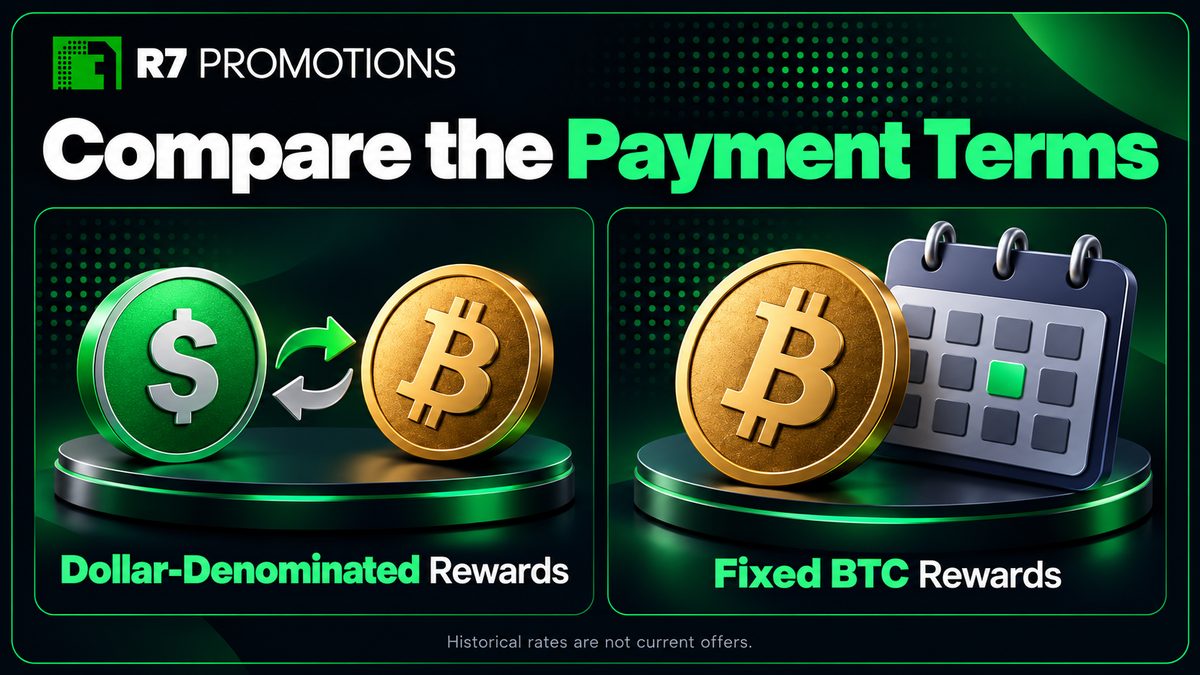
Dollar-denominated rewards and fixed-BTC rewards need separate treatment.
A dollar-denominated campaign calculates the reward in dollars before converting it to BTC under its payment rules. A fixed-BTC campaign specifies the Bitcoin amount itself, so its dollar value changes with the market.
Historical forum overview records illustrate the difference:
| Campaign | Recorded BTC reward structure | Weekly amount under those recorded terms |
|---|---|---|
| Bitmixer | 0.0007 BTC per eligible post, with a 50-post maximum | Up to 0.035 BTC |
| FortuneJack | Fixed weekly amount for the top listed ranks | 0.02 BTC |
| YOLOdice | 0.00035 BTC per eligible post for the top listed ranks, with a 40-post maximum | Up to 0.014 BTC |
These are historical examples, not claims that each figure was the campaign’s highest-ever rate.
A different period could have different terms. That is why a campaign name alone is insufficient evidence for a payment comparison.
Why today’s Bitcoin price does not establish the original reward value
Suppose someone earned 0.01 BTC from a campaign years ago. Multiplying that payment by today’s Bitcoin price tells you what the same amount of Bitcoin would be worth today.
It does not tell you what the work was worth in dollars when it was performed.
For a fair historical comparison, distinguish:
The BTC amount earned.
Its approximate value at the time.
Any later change in the value of that Bitcoin.
If historical dollar conversions are added, each needs a payment date and a stated exchange-rate source. Without that context, comparisons can exaggerate how much an advertiser was paying at the time.
What high rates can—and cannot—tell an advertiser
A substantial reward allocation can make a campaign attractive to experienced contributors. It can also support a selective roster and demanding participation standards.
But the rate does not establish audience suitability, genuine interest, customer confidence or sales.
For a cryptocurrency exchange, useful exposure means reaching people who may eventually need the service and giving them reasons to consider it. For a gambling platform, familiarity develops alongside customer experiences of support, withdrawals and the way complaints are handled.
Repeated signature visibility can help a brand become recognizable. The business’s conduct determines what people come to associate with that recognition.
Paying more without improving participant selection, campaign checks or the customer experience can increase costs without producing a stronger reputation.
What project owners should learn from these examples
Historical rates are useful context, not a pricing formula for a new campaign.
Begin with the audience, suitable participants and a budget the business can sustain. Then agree on the reward structure, posting limits, quality standards and funding process.
Before approving a proposal, ask:
Is the quoted amount a standard payment or a conditional maximum?
Which ranks or special categories qualify?
Are bonuses included?
Is the reward fixed in BTC or converted from dollars?
Who holds campaign funds and makes payments?
What activity is excluded?
What reports will management receive?
For practical calculations, read How Much Does a Bitcointalk Signature Campaign Cost?
That article explains how participant rewards fit alongside management, setup and funding requirements. This historical comparison serves a different purpose: helping you interpret the numbers behind campaign headlines.
Frequently asked questions
Was ChipMixer the highest-paying signature campaign ever?
Its cited dollar-denominated terms supported a $300 weekly maximum. Establishing an absolute all-time record would require checking every relevant campaign period, special arrangement and payment model. This article does not make that claim.
Did every Sinbad participant qualify for $225 per week?
No. The cited $225 maximum applied to a special merit tier. Other payroll categories had different rates.
Were Sherbet participants paid $130 every week?
The cited Legendary base rate supported up to $100. A separate $30 quality bonus could raise the total for selected participants.
Do these historical rates show what a new campaign should pay?
No. A suitable budget depends on the participants, responsibilities, reward limits and duration. Historical rates are reference points rather than a current quotation.
Are the listed campaigns open for applications?
This article is a historical comparison. It should not be used to determine current availability or whether any listed business is operating.
Plan a campaign around your business
I approach signature campaign management by considering the people a brand wants to reach, the quality of participation and the funding needed to maintain a consistent presence.
A headline reward is only one part of that plan. Participant selection, activity checks, communications and payment coordination determine how the campaign operates week after week.
Explore my campaign portfolio and Signature Campaign Management service to see how I approach the work.
If you are considering a campaign, tell me about your business and the budget you can comfortably sustain. I’ll help you turn that into a clear participation plan rather than copying a historical headline rate.